Top all-time · #817
pharr.org
Personal blog · pharr.org/matt/blogprogrammingsystems
pharr.org is a personal blog at pharr.org about programming and systems. Since 2017, 80 different Hacker News readers have linked it 115 times, most often “The Story on ISPC (Intel SPMD Program Compiler)”. No feed was found, so read it on the site itself.
Sometimes recommended · 6 of 40 sampled comments recommend it?
Why HN links it
HN readers link Matt Pharr's blog for its series on the history and design of ispc, the SPMD compiler for SIMD code, and for graphics rendering posts such as the Moana island renders in pbrt.
Summarised by Claude from a sample of 40 HN comments that link here. Each comment is marked recommending, critical or neutral (citing without judging); how this works.
Most-linked posts?
- The Story on ISPC (Intel SPMD Program Compiler)14 people · 15 mentions · first linked 2021-11-14
- The story of ispc: all the links7 people · 8 mentions · first linked 2022-03-18
- The story of ispc: Origins (part 1)7 people · 7 mentions · first linked 2018-04-18
- The story of ISPC: origins (part 1)6 people · 6 mentions · first linked 2018-09-11
- The story of ispc: all the links (2018)6 people · 6 mentions · first linked 2018-10-19
- Some News About the 4th Edition of Physically Based Rendering4 people · 4 mentions · first linked 2022-12-23
- Accurate Differences of Products with Kahan's Algorithm4 people · 4 mentions · first linked 2019-11-04
- The Story of ISPC: Intel SPMD Program Compiler4 people · 4 mentions · first linked 2018-05-01
- The story of ispc: retrospective (2018)3 people · 3 mentions · first linked 2019-10-25
- Swallowing the elephant (part 1)3 people · 3 mentions · first linked 2018-07-09
What Hacker News says?
I love Matt Pharr's blog [0]. He's one of the authors of the Physically Based Rendering book [1] and his blog is mostly centered around that topic, with really well written and interesting articles. [0] https://pharr.org/matt/blog/ [1] https://www.pbrt.org/
Comment linking /matt/blog/
on “Ask HN: Favorite Blogs by Individuals?”Submitted My adventures getting Disney’s Moana island scene to render well with Pbrt as a story · 463 points
HN discussionOpenMP is a bad approach for the types of problems commonly encountered in games and graphics programming in my experience. Matt Pharr's excellent series of articles on the history of ISPC gives some good explanations of what programming models actually work well for graphics particularly: http://pharr.org/matt/blog/2018/04/30/ispc-all.html At the time I was doing most of my SPE work (helping to optimize launch titl…
Comment linking /matt/blog/2018/04/30/ispc-all.html
on “C Is Not a Low-Level Language”Submitted The Story of ISPC: Intel SPMD Program Compiler as a story · 160 points
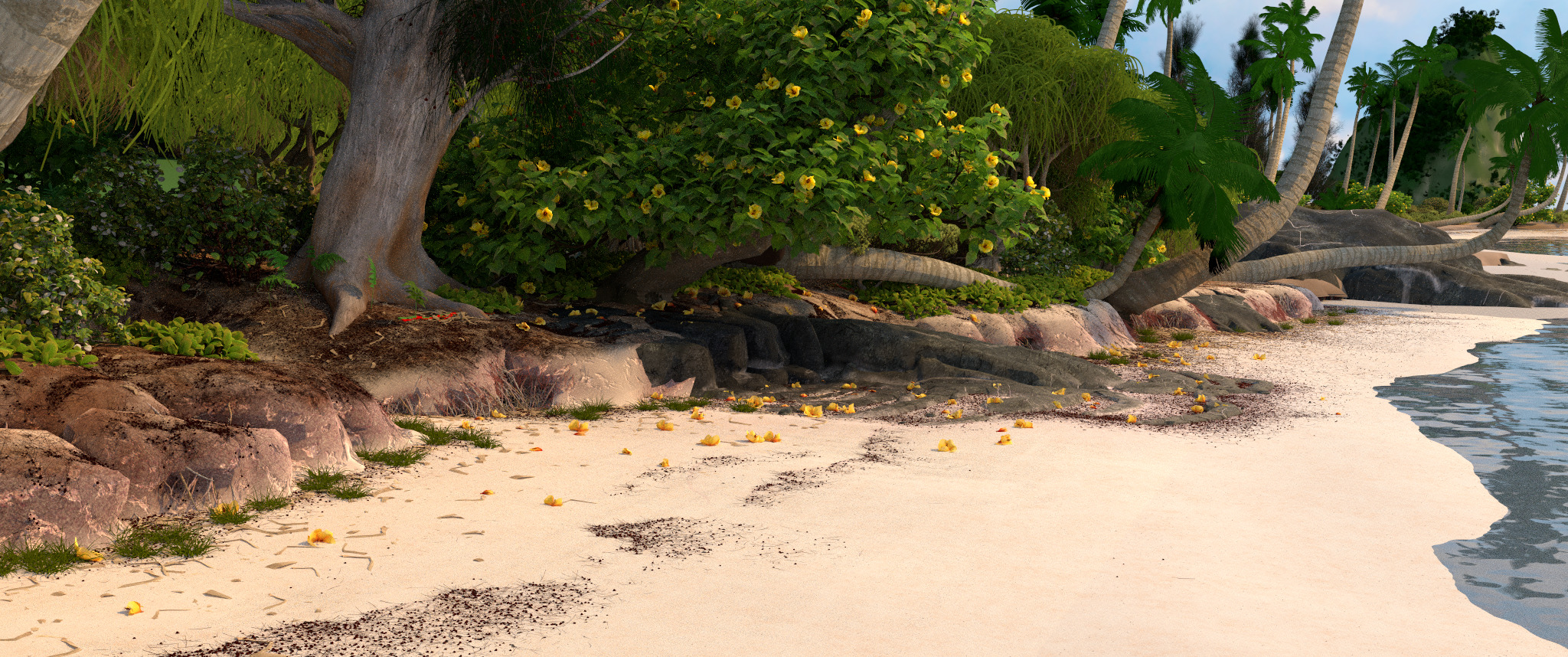
HN discussionHow close are the renders to movie-accurate (that is, what's missing?)? Looking at e.g. [0], it seems to be missing a lot vs what is seen in the film. Are features missing compared to the original, were things missing from the scene description, or something else? The shorelines from screen stills in particular seem much more sophisticated [1]. [0] http://pharr.org/matt/blog/images/pbrt-moana-beach.jpg [1] https://v…
Comment linking /matt/blog/images/pbrt-moana-beach.jpg
on “My adventures getting Disney’s Moana island scene to render well with Pbrt”Submitted The story of ispc: all the links (2018) as a story · 42 points
HN discussion> not software per [se] and more so Developer Experience This aligns with my experiences trying to use Intel software. The software was often technically very good, but the user experience trying to use it was horrible, and god help you if you got an error. Larrabee all over, really. I suppose linking to [1] and [2] is probably germane for this discussion. I swear there was another blogpost explaining the tradeoffs…
Comment linking /matt/blog/2018/04/18/ispc-origins
on “Pat Gelsinger was wrong for Intel”Submitted The story of ISPC: origins (part 1) as a story · 36 points
HN discussionSome of my favourite reading on this topic is Matt Pharr's retrospective on ISPC: https://pharr.org/matt/blog/2018/04/30/ispc-all
Comment linking /matt/blog/2018/04/30/ispc-all
on “Nvidia to join Dow Jones Industrial Average, replacing Intel”Submitted The story of ispc: volta is born (part 2) as a story · 34 points
HN discussionMatt Pharr recently released an early version of PBRTv4, which has been rewritten extensively to make heavy use of Optix and the GPU. Given that he previously wrote a series on rendering Moana using PBRTv3, I wonder if v4 could be used as a comparison? https://pharr.org/matt/blog/2020/08/19/pbrt-v4-released.html
Comment linking /matt/blog/2020/08/19/pbrt-v4-released.html
on “Moana Motunui Renderer on GPU”Submitted Swallowing the elephant (part 1) as a story · 29 points
HN discussionA couple of other attempts at rendering the Moana scene with something other than Hyperion: - Matt Pharr (author of pbrt) -- 6 part series: https://pharr.org/matt/blog/2018/07/08/moana-island-pbrt-1.h... - Joe Schutte (WDAS): https://schuttejoe.github.io/post/disneybsdf/
Comment linking /matt/blog/2018/07/08/moana-island-pbrt-1.html
on “Moana Motunui Renderer on GPU”Submitted Rendering in Camera Space(ish) as a story · 17 points
HN discussionIntel is behind in fab technology. I don't think the problem is that Intel's chip designs are what's holding them back. AMD offered better multi core performance and Intel responded with more cores as well. However, I do believe that Intel suffers from an awful corporate environment. There was a story about ISPC [0] with one chapter [1] talking about the culture at the company. [0] https://pharr.org/matt/blog/2018/0…
Comment linking /matt/blog/2018/04/28/ispc-talks-and-departure.html
on “ARM Mac Impact on Intel”Submitted The story of ispc: Origins (part 1) as a story · 10 points
HN discussionDo you by any chance know how much RAM the CPUs in a render farm need? That would help to put the 48GB in context... Answering my own question: http://pharr.org/matt/blog/2018/07/08/moana-island-pbrt-1.ht... “...with memory use upward of 70 GB during rendering.” The author is later able to reduce the amount of memory significantly by rewriting small parts of his renderer.
Comment linking /matt/blog/2018/07/08/moana-island-pbrt-1.html
on “Nvidia Unveils Quadro RTX, a Raytracing GPU”Submitted The Story on ISPC (Intel SPMD Program Compiler) as a story · 4 points
HN discussionhttps://pharr.org/matt/blog/2018/07/16/moana-island-pbrt-all
Comment linking /matt/blog/2018/07/16/moana-island-pbrt-all
on “Improving performance of rav1d video decoder”Submitted Goodbye to Twitter (and all that) as a story · 4 points
HN discussionFrom a cursory look at the code, I don't see any use of fused-multiply-add (FMA) which would likely help with precision issues in a number of places with the float version. The "problem in more detail"[1] readme specifically calls out computation of `x^2 - y^2` as a source for error, and that has methods that dramatically reduce error with FMAs[2]. [1] https://github.com/ProfJski/FloatCompMandelbrot/blob/master/...…
Comment linking /matt/blog/2019/11/03/difference-of-floats
on “How Mandelbrot set images are affected by floating point precision”Submitted The story of the Intel ispc compiler as a story · 4 points
HN discussion> Intel ISPC is a great project btw if you need high level code that targets SSE, AVX, AVX512 and even ARM NEON It's pretty funny how NEON ended up in there. A former Intel employee decided to implement it for fun and submitted it as a pull request, which Intel quietly ignored for obvious reasons, but then another former Intel employee who still had commit rights merged the PR, and the optics of publicly reverting i…
Comment linking /matt/blog/2018/04/29/ispc-retrospective
on “Understanding SIMD: Infinite complexity of trivial problems”Submitted The story of ispc: C's influence and implementing SPMD on SIMD (part 4) as a story · 4 points
HN discussionHaven't seen it mentioned in here: Matt Phar is also behind ispc, a subset of C (?) in the spirit of SPMD, and an optimizing compiler (based on llvm iirc). It can target Intel AVX (up to avx512, I think?) and is quite fun to work with. It can help out if you're in a rut of using intrinsics and cursed cuda kernels. A fresh take on a programming model. I recommend taking a look at the amazing story behind it https://p…
Comment linking /matt/blog/2018/04/30/ispc-all
on “Physically Based Rendering: From theory to implementation (2016)”Submitted Ispc: Intel implicit SPMD single program multiple data compiler as a story · 3 points
HN discussionSome favorites: - Bruce Dawson - Chrome engineer ( https://randomascii.wordpress.com/ ) - Matt Pharr - Graphics researcher ( https://pharr.org/matt/blog/ ) - Pete Shirley - Graphics researcher ( http://psgraphics.blogspot.com/ )
Comment linking /matt/blog/
on “Ask HN: Best Engineering Blog Posts?”Submitted The story of ispc: all the links as a story · 3 points
HN discussionJust so people don't get too hung up on speed issues, please realize that the major advantage with raytracing over rasterization is that it's trivially parallelizable. Naive implementations of ray tracing and rasterization run at O(log n) and O(n) respectively, so at some point in the near future ray tracing (or its optimized version ray marching) will likely win out. See the "Calculation effort" graph mid-page: htt…
Comment linking /matt/blog/2018/05/27/nvidia-bound.html
on “Literate raytracer: a simple implementation of raytracing in Javascript”Submitted Some News About the 4th Edition of Physically Based Rendering as a story · 3 points
HN discussion